Why Pay for a File When Free Ones Exist?
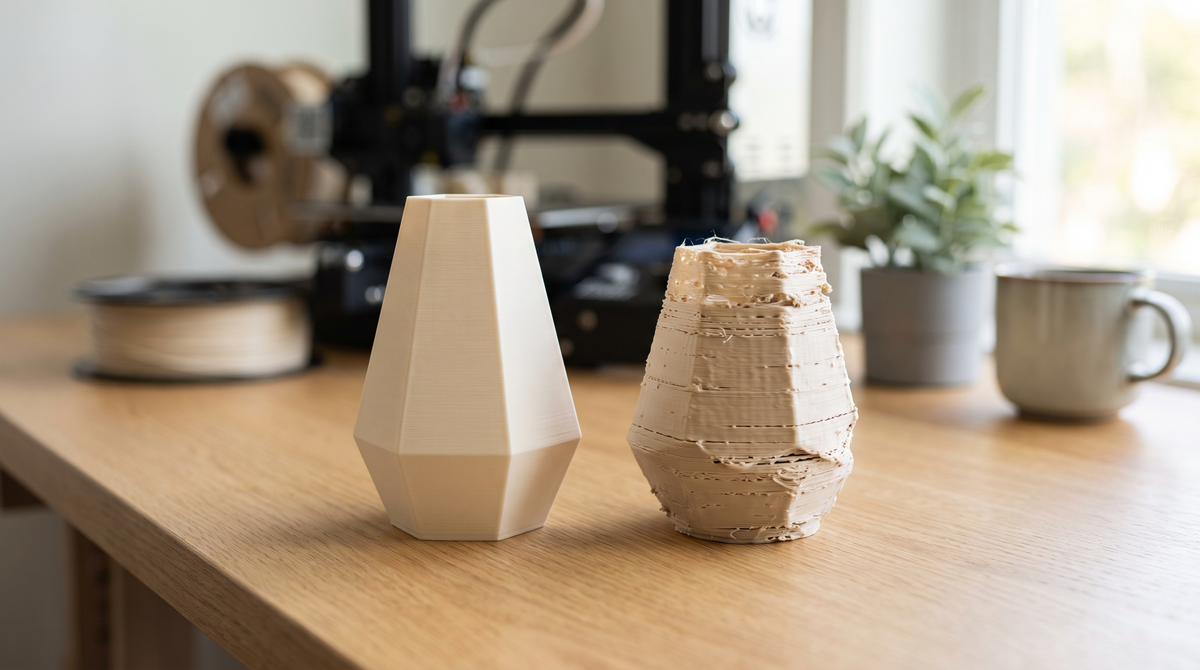
I sell digital files, so I have an obvious interest here. Let me try to answer this properly anyway, including the cases where the answer is "don't."
The free sites are genuinely excellent
Let's start there, because any answer that pretends otherwise isn't worth reading.
Printables, MakerWorld, Thingiverse and Cults3D host an enormous amount of genuinely good work, given away by people who didn't have to. A lot of it is better than a lot of what's sold.
If you want a common object — a phone stand, a hook, a box, a bracket — it exists for free and it's probably fine. Go and get it. That's not a grudging admission, it's just true.
What a free STL doesn't include
Here's the actual gap, and it's not about the shape.
An STL describes a surface. That's the entire format. It cannot contain layer height, print speed, temperature, orientation, whether it needs supports, what material it was designed for, or what tolerances it was tested at.
So you download it, your slicer applies whatever profile you happen to have loaded, and you find out whether that works by printing it.
For a simple chunky object, almost any profile works. For something with fine detail, thin walls, or moving parts, it very much matters — and the file has no way to tell you.
Most disappointing prints are a decent model with the wrong setup, not a bad model.
When paying is genuinely worth it
Moving parts and tight tolerances. The strongest case. A print-in-place mechanism lives or dies on a clearance gap a fraction of a millimeter wide, and that depends on flow calibration, first-layer squish and cooling. Handing someone a bare STL of one is handing them a guess.
When you want it right tonight. If it's 9pm and you want a finished thing rather than a project, paying for tested settings buys you the evening.
Fine detail. Small text, delicate features. These fail in specific ways with the wrong wall generator and speed, and a tested profile skips that.
Commercial use. Many free files are non-commercial licensed. If you're selling prints, you need a file whose terms actually permit it — see how model licenses work.
When you shouldn't pay
For a simple shape. A box, a hook, a basic stand. Get it free.
When you enjoy the tuning. Plenty of people find dialing in settings the fun part. If that's you, the thing being sold has no value to you.
When the listing doesn't say what's in it. If a seller doesn't state whether settings are included, what it's been tested on, and what license you get, that tells you they haven't done the work. That's most paid listings, honestly.
For something you could remix from free in ten minutes.
What should actually be in a paid file
This is the standard I'd hold anyone to, including me:
- A 3MF project file with the tested profile embedded — not a bare mesh in a 3MF wrapper
- An STL too, so you can slice it yourself if the profile doesn't suit your machine
- A statement of what it was tested on — printer, material, whether it needs supports
- Clear license terms, so you know what you're allowed to do
- Notes on what to change if the first one isn't right
If a listing has none of that, you're paying for a shape you could probably find free.
The honest framing
You're not buying geometry. Geometry is abundant and often free.
You're buying someone else's failed prints — the evenings they spent finding out that the clearance needed to be 0.25mm and not 0.2mm, that it had to be oriented this way, that the outer wall needed slowing down.
Sometimes that's worth $15. Sometimes you'd rather do it yourself and learn something, and that's a completely legitimate choice.
What I'd push back on is the idea that a paid file is automatically better. It's only better if the work is actually in it — which is why I'd rather tell you what's in mine than tell you that free files are bad. They aren't.
Have you bought a file that turned out to be worth it — or one that didn't? I'd like to hear both. 👀