The Stacked Pumpkin Candle Holder I Can't Stop Printing
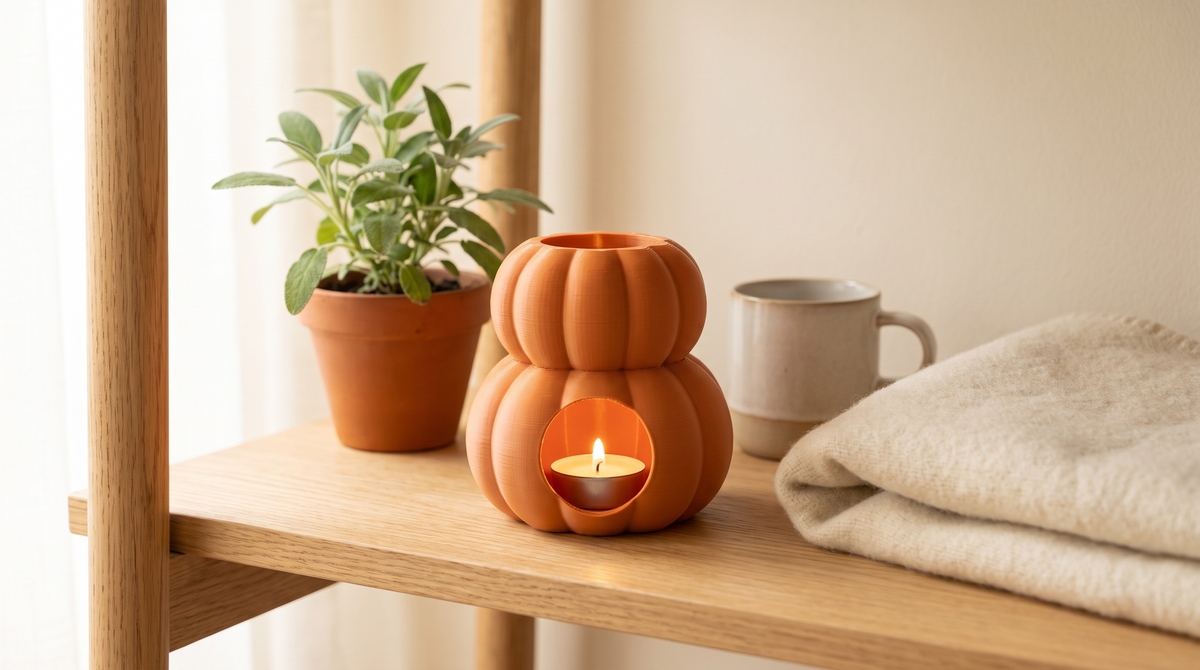
I've printed this one so many times now that I could probably slice it in my sleep, and I still stop and look at it every time it comes off the plate.
Three pumpkins, stacked, hollow, with carved faces and space for a tea light. It sounds simple. The reason it works is the light.
Why lit decor beats flat decor
Here's the thing I didn't appreciate until I made one: a printed object in daylight looks like a printed object. You can see the layer lines. You know it's plastic. It's fine, but it reads as "3D printed thing."
Put a light source inside it and something changes completely. The light comes through the cut-outs, the layer lines catch the glow and turn into texture rather than a flaw, and the whole piece stops looking manufactured and starts looking made.
It's the single highest-impact trick in printed decor and it costs you nothing but a tea light.
Safety, said plainly
Use an LED tea light. Not a real candle.
PLA softens somewhere around 60°C, which is well within what a real flame will do to the inside of an enclosed plastic object. It won't dramatically burst into flames — it'll sag, warp, and ruin itself, and that's the good outcome.
LED tea lights are a couple of pounds for a pack, they flicker convincingly, and you can leave them on with a toddler in the house. There is no version of this where a real flame is worth it.
Printing it
Color matters more than usual. A warm orange or a translucent amber is what you want. A dark or heavily pigmented filament blocks the light and you lose the entire effect. If you have translucent PLA, this is what it's for.
Wall count is the dial. Fewer walls means more light through the body of the pumpkin, not just the carved faces. Two walls gives a lovely overall glow; four makes it solid so only the cut-outs shine. Both look good — they're just different pieces.
It's a tall print. Three stacked shapes means a fair bit of height, which means adhesion matters. Make sure your plate is clean. A print that lets go at hour three is a genuinely upsetting way to spend an evening.
Don't rush the top. The stem and the upper curves are where a too-fast print shows. Slowing the outer wall down helps more than you'd expect.
Where to put it
Somewhere it'll actually be seen in the evening, because that's when it earns its keep. A mantel, a shelf, a windowsill facing into the room.
Ours lives on the shelf in the front room and gets switched on at dusk through October. It's become one of those small seasonal markers — the light goes on, it's officially autumn.
I did try one outside on the porch. It was fine for a few weeks, but PLA and sustained sun don't mix long-term, and it went slightly brittle. If you want an outdoor one, print it in PETG and accept it'll take a bit more tuning.
Make a set
One is nice. Three at slightly different heights is much better — it stops looking like a single ornament and starts looking like a deliberate display.
Scaling the same model to 90% and 80% gives you a set without designing anything new, and because it's the same file you already know it prints cleanly at those sizes.
The files are here, with my settings saved in the 3MF and every pumpkin its own piece so you can color them however you like. If you'd rather not spend three evenings on it, I print them to order here in whatever color you want.
Common questions
Does it need supports?
No — the shapes are designed so the overhangs stay shallow enough to print unsupported. That's deliberate; supports inside a hollow decorative piece are miserable to remove.
How long does it take?
Several hours, depending on size and layer height. It's an overnight or a full-afternoon print rather than a quick one.
Can I use a real candle if I'm careful?
I'd genuinely rather you didn't. The heat is enclosed and PLA has no margin for it.
What if I want it bigger?
Scales up fine. Watch your plate size and be aware the print time climbs quickly with height.
What should I stack next? I've been told I have a problem with stacking things and I don't disagree. 🎃