Mom Side Hustle: What My Printer Actually Earns
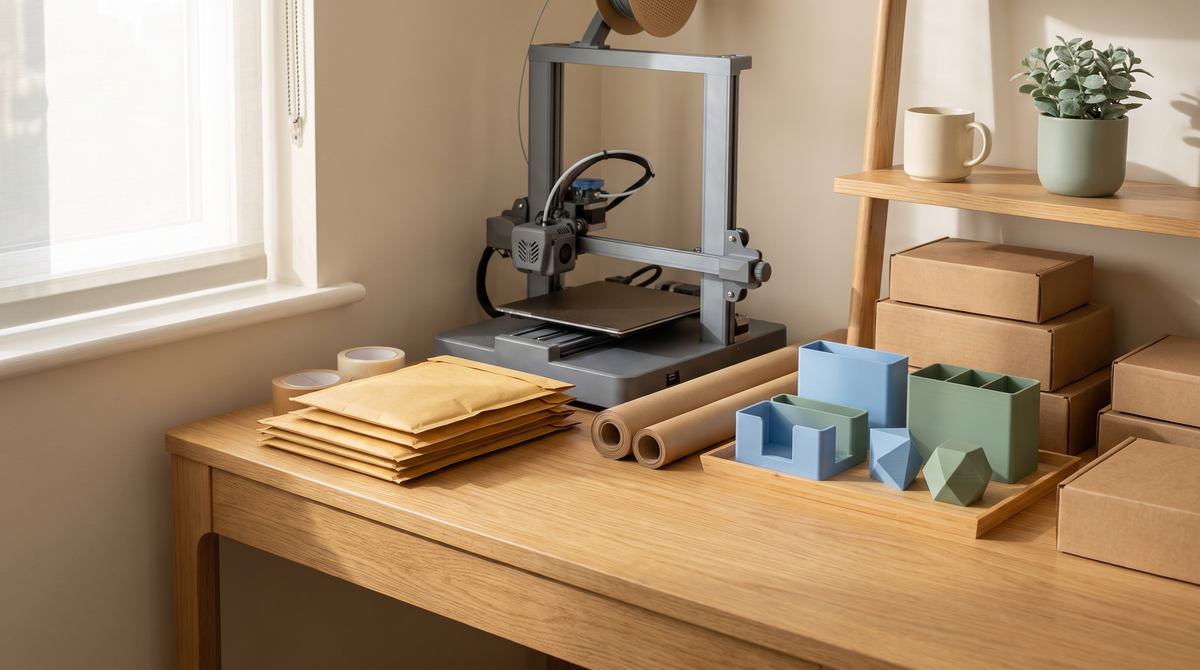
Let me be upfront: this is not a "quit your job with a 3D printer" post. Those exist and I don't believe them.
This is what it actually looks like running a small printing shop from a house, with two small kids, in the evenings.
The filament is the cheapest part
The number that surprises people: material cost on a small item is often under a dollar.
A keychain uses a few grams. A wristlet a bit more. On raw material alone the margins look extraordinary, which is why so many people start.
Then you count everything else.
Where the money actually goes
Time, overwhelmingly. Not print time — your time. Slicing, plate changes, removing parts, trimming, sanding, attaching keyrings, photographing, listing, packing, answering messages. A $10 item can easily involve 20 minutes of hands-on work, and that's the real cost.
Failures. Roughly one in ten, and each one is material plus the time to reprint.
Packaging. Boxes, mailers, labels, tissue. Small per unit, real in aggregate.
Fees. Platform fees, payment processing, and shipping that customers reasonably expect to be cheap or free.
The machine. Nozzles, plates, belts, the occasional part. It's a machine that runs constantly and it wears.
Once you count all of it honestly, a $10 keychain is not a $9 profit. It's closer to a few dollars, and that's before you pay yourself for the twenty minutes.
How to price it
The formula that stopped me underpricing:
Material + (your hourly rate × hands-on time) + fees + packaging, then multiply for failures.
The part everyone skips is their own time. If you don't pay yourself, you haven't got a business — you've got an expensive hobby with customers, and it will eventually feel like it.
I underpriced for months because it felt cheeky to charge for something that "only cost a dollar in filament." That was a mistake and it made the work feel worse.
What actually sells
Personalized things. Names, specifically. By a distance the most reliable seller, because a name can't be bought generically.
Things solving a specific annoyance. Not "a cool print" — a fix for something people have complained about.
Seasonal, in the right window. Halloween in September. Gifts in November. Miss the window and it's dead stock in time rather than in a box.
Digital files. The one category with genuinely different economics — no printing, no packing, no shipping, and it scales. Much harder to get right, because you're competing with free and you have to be clearly better than free.
The digital file question
This is where my thinking changed most.
Selling physical prints means trading hours for money with a hard ceiling — you can only print so much. Selling files means the work is front-loaded into design and testing, and after that it's the same effort whether one person buys it or a hundred.
But you can't just upload an STL and expect it to sell, because free STLs are abundant and good. What people pay for is the part that isn't in a free file: the tested settings, the tolerances, the orientation, the knowledge that it works.
That's genuinely harder to produce than a shape. It's also the only defensible thing to sell.
What I'd tell someone starting
Start with what you already make for yourself. If you printed it because you needed it, other people need it too. Every product I sell started that way.
Don't buy a second printer yet. Capacity isn't your constraint at the start. Demand is.
Photograph well. Genuinely the highest-return skill. A good photo on a clean background outsells a better product photographed badly.
Price for your time from day one. Raising prices later is much harder than starting right.
Is it worth it?
For me, yes — but not because of the money, which is real but modest.
It's worth it because it fits around the kids, because I like the making, and because it turned a hobby into something that pays for itself. That's a genuinely good outcome. It is not the same as a job replacement, and I'd be lying if I said otherwise.
If you sell prints — what surprised you most about the economics? For me it was how much time the finishing takes. 💅🏼